YouTube Content Ideas for the Psychology and Facts Niche: An AI-Assisted Research Workflow
There is one thing the YouTube algorithm reliably rewards: curiosity. That is the whole reason the psychology and facts niche keeps producing outsized channels, and why it is still one of the better places to look for YouTube content ideas if you are building faceless videos for English-speaking viewers.
You have seen the format even if you have never studied it:
- “7 psychological facts that make people drawn to you”
- “Why your brain gets attached to people who hurt you”
- “The psychological loop that keeps you on your phone”
These videos tend to earn a high click-through rate, hold attention better than their production budget suggests, adapt cleanly into Shorts, and get picked up by the browse and suggested surfaces. Most importantly, they are evergreen. A good psychology video can still be pulling views three years after upload.
I have been building faceless channels since 2017, mainly for audiences in the US, the UK, Germany and Japan. Below is the actual research process I use before committing a channel to a topic in this space. No part of it requires you to appear on camera, and none of it is “sit down and think of ideas”.
Why psychology and facts content travels so well
The reason is unglamorous: people are endlessly curious about themselves.
Human behaviour, body language, manipulation tactics, attachment, memory, attention: these hit an instinct that does not depend on country, language or culture. That makes the niche unusually portable, which is exactly what you want when your audience is on the other side of the world from you.
The real advantage is shelf life
Trend content decays. A video about a current news cycle is worth very little in eight weeks. Psychology content behaves the opposite way. A video titled something like “Why people ignore the person they like” can keep accumulating views for years, because the question never stops being asked.
That is why faceless creators like this niche for building a content library rather than a treadmill. You are not obliged to ignore trends entirely, but the base of the channel can be material that keeps working while you sleep.
Step 1: Build a clean research environment
This step is boring, everyone skips it, and skipping it quietly ruins everything that follows.
Your normal YouTube account is feeding you bad data
If your account has spent years watching music, gaming, football or entertainment in your own language, that is what YouTube will keep showing you. You will not see what is actually taking off in the market you want to serve. You will see what you like.
Research done on that account is not research. It is a mirror.
What to do instead
Create a separate brand account that you use for nothing except research: watching competitors, studying formats, and reading comments. Do not watch anything on it for entertainment. Its recommendation feed is a tool, and you want the tool calibrated.
Set the location to the market you are targeting
Set the research account’s country and interface language to the market you want, typically the US or the UK. This changes what the homepage and the trending surfaces show you. Within a week or two of only watching relevant videos, that account will start surfacing the psychology channels, formats and Shorts that are actually moving in that market.
If you are worried that you do not write English well enough to work in this niche, that is a solvable problem and not the blocker most people assume. Scripting and voice tools handle a great deal of it now, as long as you are willing to check the output rather than publish it blind.
Step 2: Filter ideas through six green lights
The most common mistake: someone finds a channel with ten million subscribers, concludes the niche is healthy, and starts. That is the wrong reading. A giant channel proves the topic once worked. It does not prove there is space for a new one.
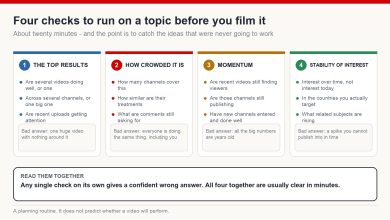
What you actually want to know is whether YouTube is still pushing this material to new channels. Search terms like psychology facts, human behaviour, dark psychology or body language, then look for these signals.
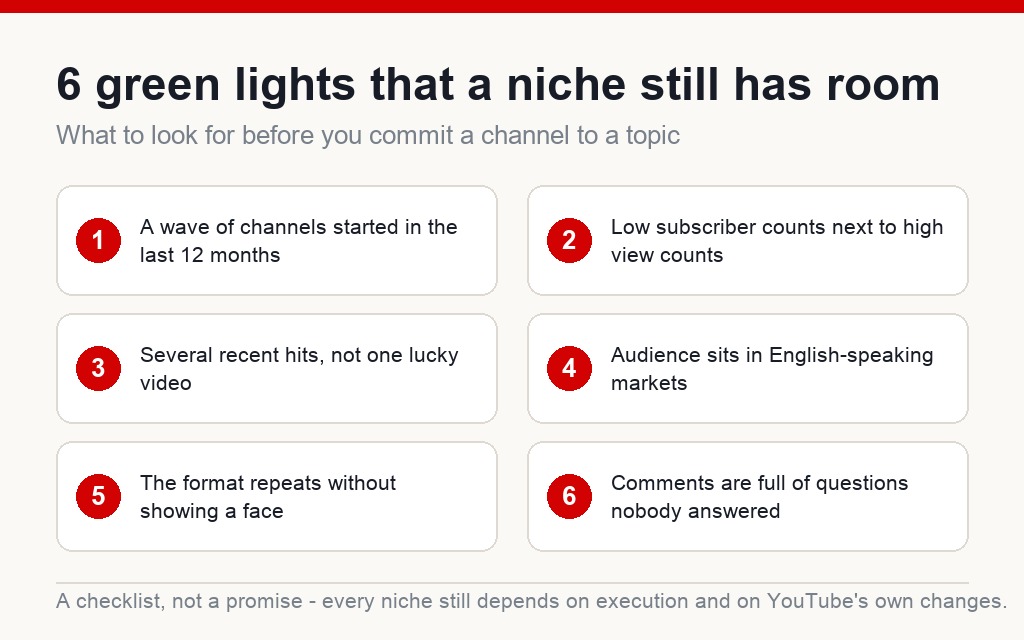
1. Young channels are already winning
Channels created in the last several months with real traction tell you the niche is still expanding, not closed.
2. Low subscriber counts next to high view counts
This is the strongest single signal. A channel under 50,000 subscribers with videos in the hundreds of thousands of views means the platform is distributing that content to people who do not follow the channel. That is the distribution you need as a newcomer.
3. Several recent hits, not one lucky video
One outlier is noise. Look for channels where multiple recent uploads performed, and where the newest videos are still growing. That is a healthy niche rather than a single fluke.
4. The audience sits in high-value markets
Views from the US, the UK and similar markets generally carry a higher revenue per thousand views and attract stronger advertisers than views from cheaper ad markets. It is one of the main reasons so many psychology channels are produced with English AI narration by creators who do not live in those countries. Rates shift constantly, so treat any number you read as a rough guide, not a forecast.
5. The format repeats without a face
If the winning videos are narration over stock footage, motion graphics or generated visuals, the format is reproducible by you. If every hit depends on a specific presenter’s personality, it is not.
6. The comments contain unanswered questions
More on this in step 6, but check it early. A comment section full of questions the video did not answer is a niche with demand left in it.
Step 3: Take competitor videos apart with AI
This is the part that lets you learn from a winning video without producing a copy of it.
The mistake that gets channels flagged
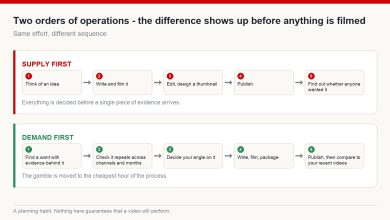
Beginners find a viral video, then rebuild it: same thumbnail concept, same title, same script beats. The result is content that reads as reused, holds attention poorly, and cannot scale, because you have no framework of your own to generate the next hundred videos from. YouTube has also become considerably stricter about this.
A better use of the same video
Pull the transcript, the title and the thumbnail into a model like Gemini or ChatGPT, and ask it to work as an analyst rather than a writer. Prompts that produce useful output:
- “Break down the first 30 seconds. What promise is made, and what tension keeps the viewer watching?”
- “Map the pacing. Where does the video change gear, and why there?”
- “Which emotional trigger is this built on: fear, validation, self-recognition, status?”
- “What did this video leave out or handle badly? Draft an outline that covers it properly.”
You are extracting structure, not sentences. The output is a lesson in storytelling that you then apply to your own angle. Check any factual claim it produces before it reaches a script, because these models will state wrong things with complete confidence.
Step 4: Compete on angle, not on topic
What matters is rarely the subject. It is the way into the subject.
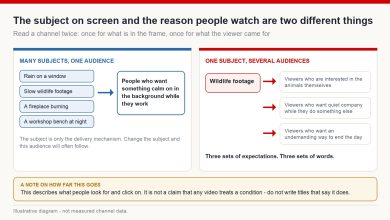
Take one topic, introversion, and look at how differently it can be framed:
- Why introverts are so consistently misread
- The psychology of people who genuinely prefer being alone
- 7 traits that make introverts more magnetic than they realise
- What happens in an introvert’s brain at a party
Same subject. Four different promises, four different audiences, four different thumbnails. That is an angle, and it is the smart way to generate YouTube content ideas without copying anyone. You are not taking someone’s topic. You are turning it until you find a face of it nobody has shown yet.
Step 5: Work a niche inside the niche
This is the highest-leverage decision a new channel makes.
The mistake
“My channel is about psychology.” That is a category, not a channel. YouTube cannot work out who to show it to, because the answer is everyone, which in practice means nobody.
Go narrower than feels comfortable
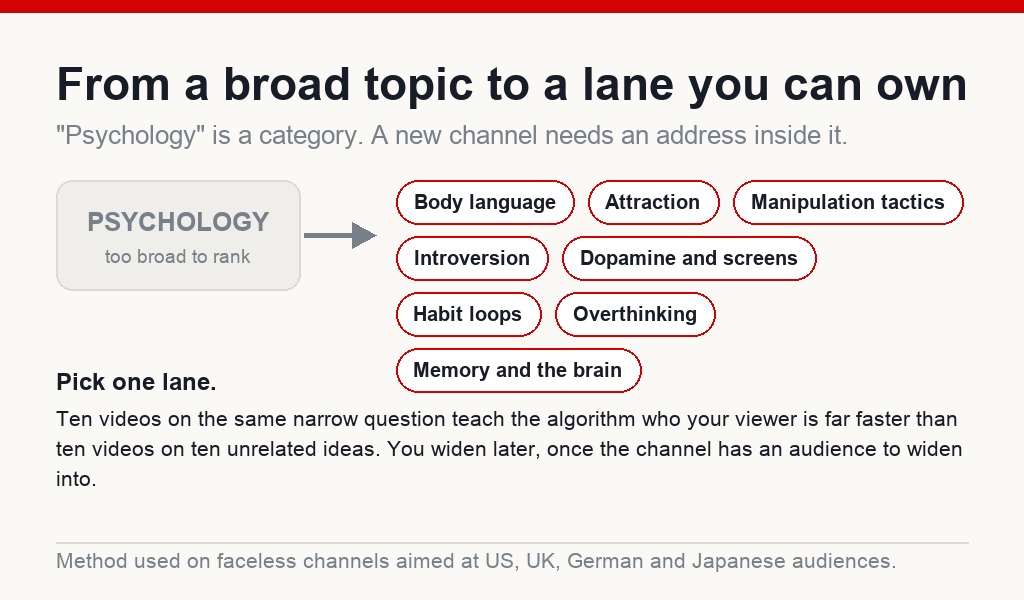
Pick a lane: body language, attraction and attachment, manipulation and influence tactics, introversion, dopamine and screen habits, habit formation, overthinking. Or on the facts side: the brain, emotion, the subconscious, decision-making.
The more specific the lane, the faster YouTube identifies your viewer, and the more accurately it can find more people like them. Ten videos on one narrow question will teach the system more than ten videos across ten unrelated ideas. You widen later, once you have an audience to widen into.
Step 6: Mine the comment sections
This is the most underused idea source on the platform, and it is free.
Open the comments under the biggest videos in your lane and read a few hundred of them. You are looking for repetition: the same question asked over and over, the same frustration, the same “but what about…” that the video never addressed.
Comments like “why does the person I like keep avoiding me?” or “how do you tell when someone is manipulating you?” are not comments. They are titles that have already been market-tested by the audience that would watch them.
Keep a running document. Fifty comment-derived questions is a content calendar.
A production workflow that currently works
Nothing here is exotic, and every piece is replaceable. The point is that the chain runs end to end without you on camera:
- Research and outline – Gemini or ChatGPT, working from your own angle and comment research
- Hook and script – written or refined with AI, then edited by you so it sounds like a person
- Voice – ElevenLabs or a comparable AI narration tool
- Visuals – stock footage, motion graphics, or generated imagery from tools such as Midjourney or Kling
- Edit – CapCut or any editor you already know, cutting both the long video and the Shorts
The tools change every few months. The order does not.
What a psychology thumbnail needs to do
This niche lives and dies on packaging more than most. The patterns that keep winning: very few words, one strong facial expression, a dark or high-contrast background, eye contact, and something deliberately withheld.
Text is usually two or three words carrying the tension, not a summary: “WHY?”, “DON’T IGNORE THIS”, “THEY NEVER TELL YOU”. The thumbnail asks the question. The video answers it.
The topics with the most room right now
Influence and manipulation
Reading people, spotting manipulation tactics, social dynamics and power. Strong curiosity pull, and a topic you must handle responsibly.
Attraction and attachment
Why people behave the way they do around someone they want. Consistently high engagement, and a young audience.
Human behaviour and cognitive effects
Named psychological effects, biases, and the “why do we all do this?” format. Very reliable, very evergreen.
Dopamine and screen habits
Attention, phone use, focus, motivation. This lane has grown fast and is not close to saturated.
Why psychology channels die early
1. Reading facts with no story around them
Nobody wants a narrated encyclopedia entry. They want a scenario they recognise, told with some tension in it.
2. A weak opening
The first few seconds decide the video. If there is no curiosity gap immediately, viewers leave and the video never gets a second chance at distribution.
3. Generic thumbnails
If your thumbnail looks like the other eleven results, click-through rate collapses regardless of how good the video is.
4. Starting too broad
Micro-niche first, expand second. This is the mistake that quietly costs people their first year.
Conclusion
Psychology and facts is one of the more durable evergreen niches available: it scales without a presenter, it suits AI-assisted production, and it works across borders. That makes it worth serious consideration if you are building for an international audience.
But good ideas do not arrive from sitting and thinking. They come from a clean research account, honest filtering, real analysis of what worked and why, and reading what your audience is already asking. YouTube pays close attention to creators who understand what makes people curious.
So do not collect facts. Learn to create curiosity, tell a story around it, hold attention, and package it properly. Results vary enormously between channels and YouTube’s systems change constantly, so treat every method here as something to test rather than something to trust. If you want a structured path for building a faceless channel aimed at English-speaking viewers, the full programme is at mmoyoutube.com.
Frequently asked questions
Is the psychology niche suitable for beginners?
It is one of the more accessible ones, because the format works without showing your face and the production chain can be largely tool-assisted. It is still competitive, so the niche choice matters more than the topic.
Does psychology content earn a good revenue per thousand views?
It is generally reasonable, particularly with a US audience, though it sits below finance and business topics. Rates change by season, market and advertiser demand, so no figure you read anywhere should be treated as a projection of your own earnings.
Should I make psychology Shorts?
Yes. The format suits short-form unusually well, and a single long video will typically yield several Shorts. Treat them as a discovery channel that feeds the long-form library.
Do I need a psychology qualification to make this content?
No, and most channels in the niche are made by non-specialists. But this material touches people’s mental health, so research properly, cite recognised sources, avoid presenting speculation as established science, and never frame a video as clinical advice.
Which AI tools work best for a faceless psychology channel?
The common combination is a reasoning model for research and scripting, an AI narration tool for voice, an image or video generator for visuals, and a straightforward editor for assembly. Every one of these is replaceable, so pick on output quality rather than on brand.